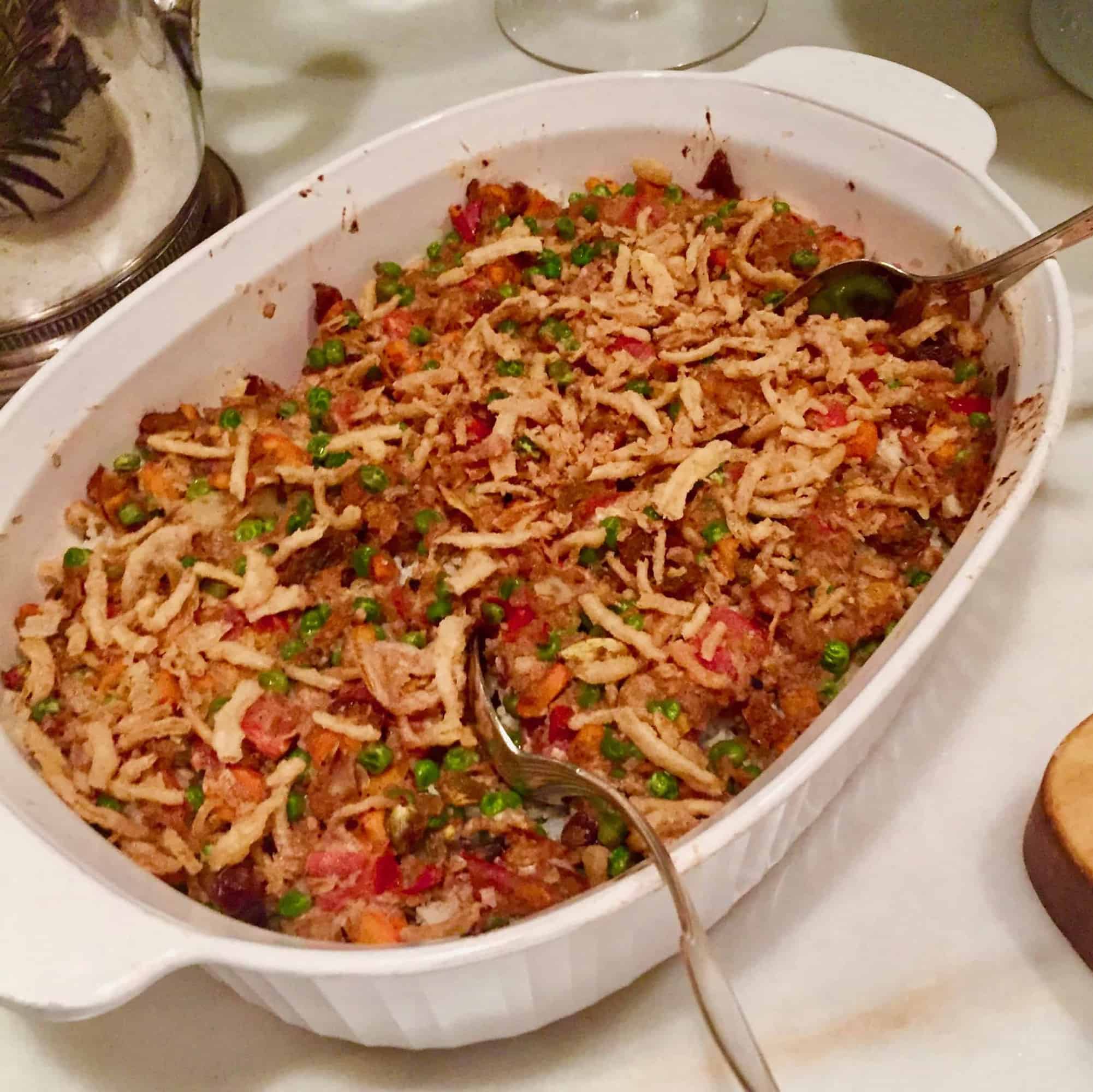
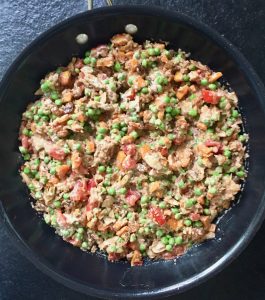
Vegetable Biryani
When I first served Biryani—that intoxicatingly spiced Indian rice dish—to a friend with Indian roots, I held my breath. You don’t mess with tradition lightly. To my delight, she didn’t just approve—she went back for seconds. That was all the encouragement I needed to share this Vegetable Biryani recipe with you. It’s an aromatic, crowd-pleasing dish that fills the kitchen with cumin, cardamom, coriander, cinnamon, and garam masala—the same spices that have now become pantry staples across America thanks to our South Asian neighbors.
This recipe, adapted from Food & Wine writer Kristen Stevens, is ideal for right now when farmers’ markets are overflowing with vibrant vegetables. The original serves 3 to 4, but I doubled it effortlessly for a dinner party, and it generously fed 8. And if you want to make the recipe even more genuinely Indian, consider ordering the real thing…https://amzn.to/487YEgz
The Many Names of Biryani
One of the most fascinating things about Biryani is how it travels—both across continents and across spelling. You’ll see it written as Biryani, Biriyani, Biriani, Birani, or even Briyani. No matter how you spell it, it remains India’s most beloved rice dish, with local versions found in nearly every region. Even Andhra in the south, which was once thought to have no native Biryani, developed its own fiery chili-laden take on the dish as its popularity spread.
A Dish with Royal and Nomadic Roots
Where does Biryani come from? That depends on whom you ask. Some food historians trace its origins to Persia, pointing to the similarities with pilaf. Others believe the Mughals fused Persian rice with Indian spice in their royal kitchens. Still others insist Arab traders brought Biryani straight to India’s shores. Vishwanath Shenoy, who has studied Biryani across India and runs a chain of Biryani restaurants, splits the difference: one branch from the Mughals, another from Arab traders. Whoever first set the pot to simmer, we’re the lucky inheritors.
Clarifications from Chennai
When I originally posted about this recipe, Jonell Galloway of The Rambling Epicure shared it on her page. A sharp-eyed reader, Anuradha Venkatesh Chenji, a culinary blogger from Chennai, kindly pointed out two things: first, that Indian languages use phonetic scripts, so the “multiple spellings” we see are strictly English translations. And second, that the state is spelled Andhra (not Andrha), where, yes, a spicier Biryani later evolved. I can’t thank her enough for setting the record straight.
The Recipe: Easy Vegetable Biryani
This Vegetable Biryani recipe is weeknight-friendly but elegant enough for entertaining. Marinate your vegetables in yogurt and spices for a few hours if time allows—Anuradha swears by this step for deeper flavor. Then layer them with basmati rice, add saffron for its golden glow, and let the magic happen.
Here’s the recipe that will make your kitchen smell like an Indian spice market and your table as festive as a holiday feast.
Vegetable Biryani
An intoxicating aroma invites guests to dig into this great gluten-free side dish that can serve as a Vegetarian main too.
By: Monte Mathews

Ingredients
- 2 cups basmati rice
- 3 cups water
- 4 tablespoons vegetable oil
- 1 large sweet onion, minced
- 2 carrots, diced ¼ inch
- 8 large garlic cloves, finely minced
- One 4-inch piece ginger, peeled and very finely minced
- 1 cup diced tomatoes (fresh, if in season, or canned)
- 8 green cardamom pods, lightly crushed
- 1 teaspoon ground coriander
- 1 teaspoon ground cumin
- 1/2 teaspoon cinnamon
- 2 teaspoon garam masala
- 2 teaspoon sea salt
- 2 cup frozen peas
- 4 tablespoons plain Greek yogurt
- 4 tablespoons raisins
- 4 tablespoons sliced almonds
Directions
- Step 1 Preheat the oven to 350°. In a small pot, combine the basmati rice and water and bring to a boil over high heat. Reduce the heat to the lowest setting, and cook, covered, for 15 minutes. Remove from the heat and let sit, covered, for 10 minutes.
- Step 2 If you have the time, mix all the tomatoes, cardamon pods, coriander, cumin, cinnamon, garam masala and sea salt together with the frozen peas, Greek yogurt and raisins and let them marinate for up to three hours.
- Step 3 In a large frying pan, heat the oil over medium high heat. Add the onion and cook until it until it is softened and lightly browned, about 7 to 8 minutes. Add the carrots and cook for 2 minutes. Add the garlic and ginger and cook for 1 minute.
- Step 4 Add the tomatoes, cardamom pods, coriander, cumin, cinnamon, garam masala and sea salt and cook for 3 minutes. If you haven’t used the spice mix as a marinade, remove from the heat and stir in the frozen peas, Greek yogurt, raisins and sliced almonds. If you have marinated the mixture, add it all at one time
- Step 5 In an ovenproof dish, spread half of the rice. Next, layer in half of the vegetables, the rest of the rice and top with the remaining vegetables. Cover with foil, put in the oven and cook for 30 to 40 minutes. Let sit for 10 minutes, covered, then uncover and serve.






This looks incredibly delicious! I can’t wait to try it. Thank you Monte ????
This is a wonderful dish, Beth. It is so great with just about any protein or all by itself. I served it with a butterflied leg of lamb. Thanks for taking the time to write. XOXO
Great article and recipe!
How thoughtful of you to write when you contributed so much to this post. Thank you!
Hi Monte,
There are a couple of really good books that cover the biryani. One is Salma Hussain’s “Pulaos from Shah Jahan’s Court”. The other is one that covers the biryani as it is prepared all over India, “Biryani” by Pratibha Karan. These two books provide great insight and history of how it developed and adapted in different parts of India. I have seen Mauritians, Fijians spell it as “biriani”, especially if they are from Francophone countries. The Mughals also brought in the trend of adding dried fruits and nuts and saffron. Over the last decade or so, biryani in India comes with a sort of gravy on the side which wasn’t the case when I first learned to make it, some 40 years ago.
Dear Ujwala, Thank you so much for taking the time to write. It was very kind of you to share these titles with us. I love Indian food and we’re very fortunate to have several excellent Indian restaurants — including one that is just moving in across the street from where we live. I am looking forward to finding Salma Hussain and Pratibha Karan’s books. I find food history almost as fascinating as eating! All best, Monte