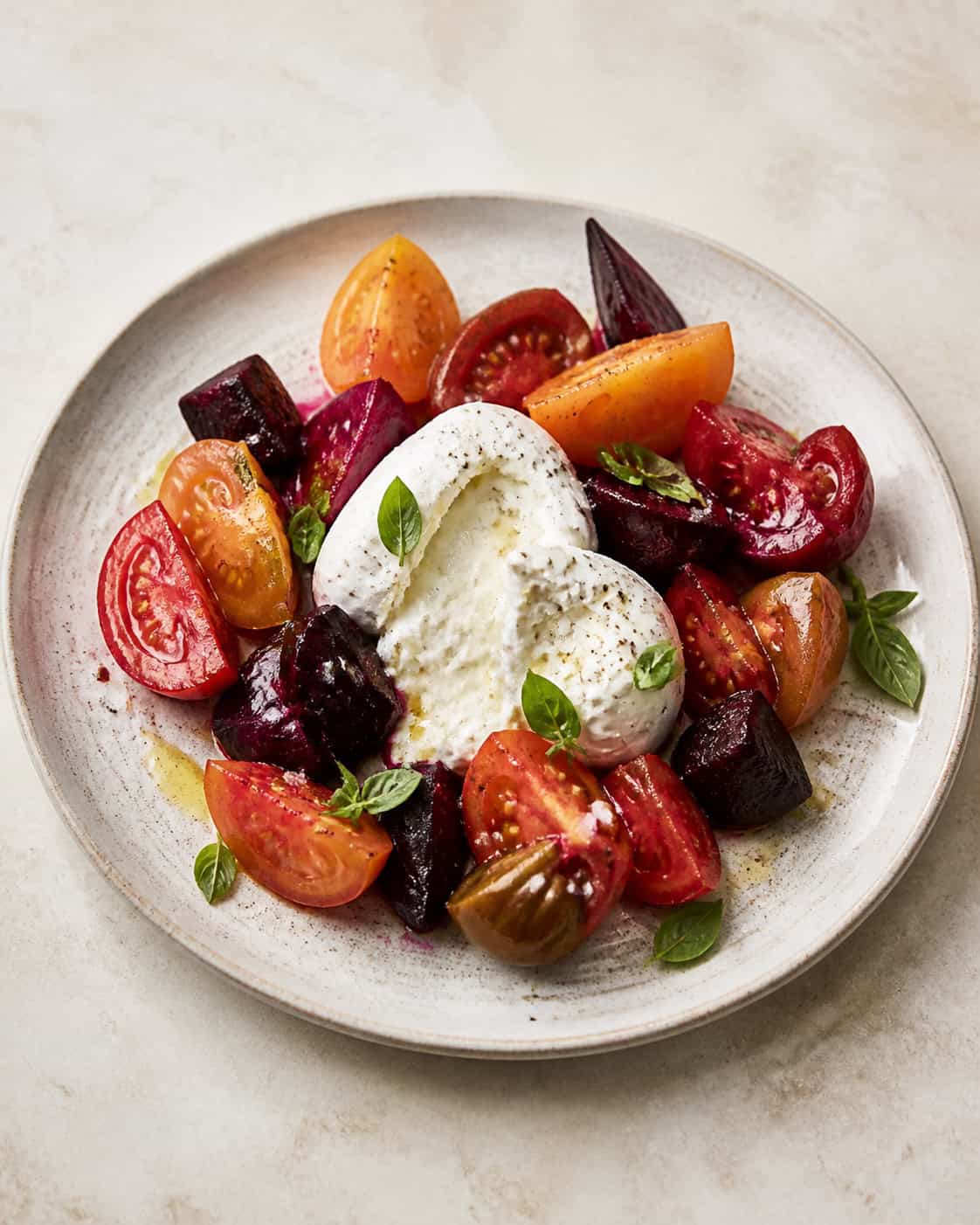
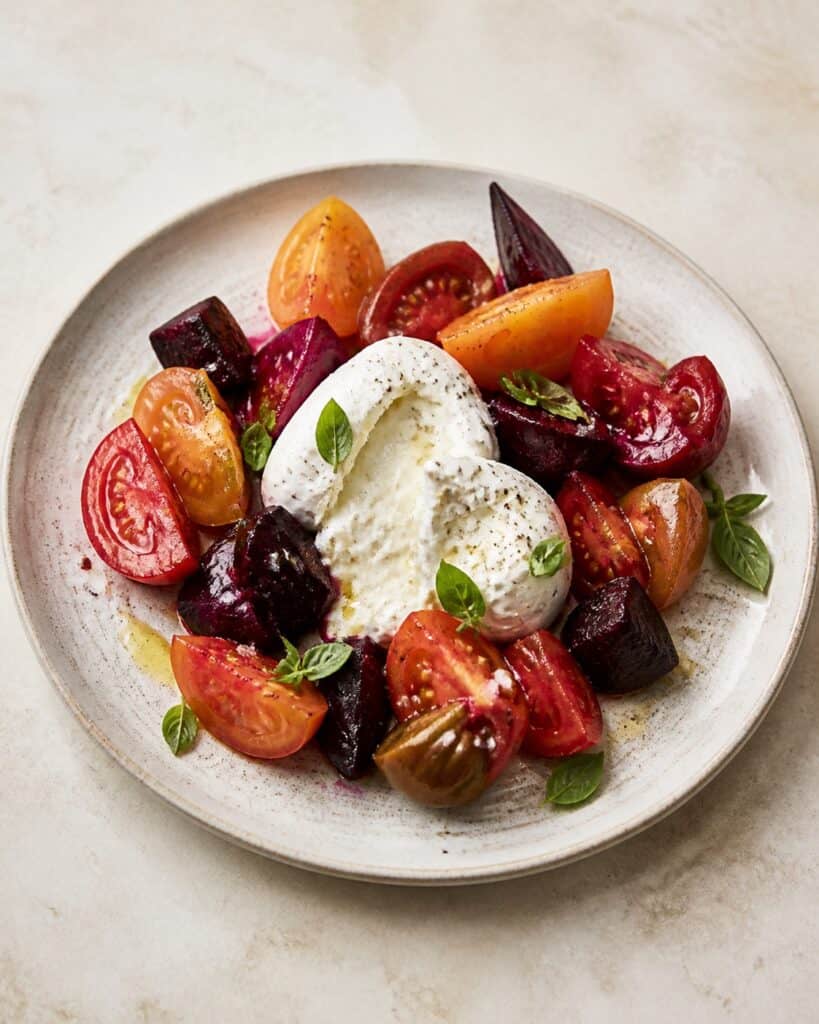
Three ingredients at their summer best, brought together with basil and a very simple balsamic dressing create this wonderful Tomato, Beet and Burrata Salad.
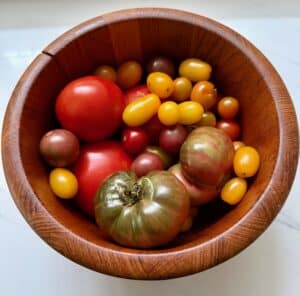
The tomatoes that set all of this in motion came from our friends Amy and Richard and their daughter Camille, who were kind enough to give them to us. A gift of properly ripe summer tomatoes is both a pleasure and a small responsibility: you want to use them while they are still perfect, and you do not want to do anything foolish to them. This salad was the answer.
It also takes us on a brief trip through Italy—from burrata’s home in Puglia to the balsamic vinegar of Modena.
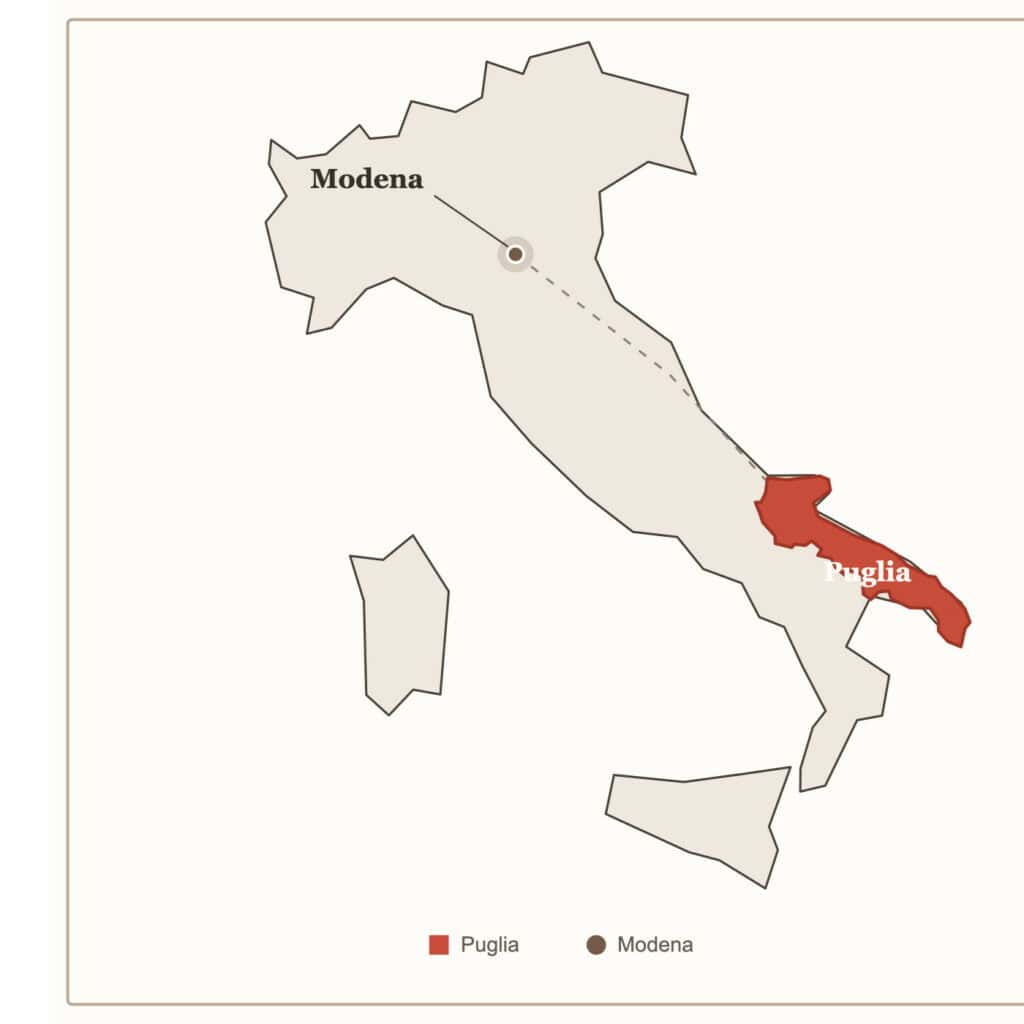
First Stop: Puglia
Burrata comes from Andria in Puglia, the heel of the Italian boot. It grew from the tradition of making mozzarella and other pasta filata, or stretched-curd cheeses. And it’s the perfect addition to our Tomato, Beet and Burrata salad.
HOW BURRATA IS MADE
The idea is ingenious: a thin sheet of mozzarella is shaped into a small purse and filled with stracciatella—shreds of stretched cheese mixed with cream. Cut through the outer skin and the creamy center tumbles out. Burrata is at once rustic and extravagant, a combination the Italians tend to manage rather better than the rest of us.
There was a practical reason for its creation as well. Using remnants from mozzarella production made economic and culinary sense. What began as a resourceful way to use every bit of the day’s cheesemaking became the thing everybody wanted most.
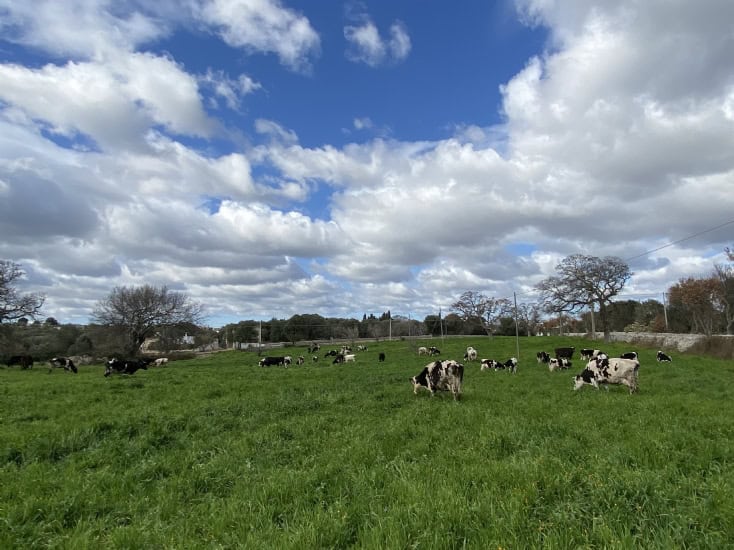
That is why I wanted our Puglia illustration to show more than a photogenic olive tree or whitewashed village. I wanted the agricultural world that produced burrata.
We found it at Masseria Fragnite in Ceglie Messapica, a working farm surrounded by olive trees, dry-stone walls, woodland and pasture. Cattle are raised there, and their milk is transformed into mozzarella, burrata and other fresh cheeses on the farm. Fortunately, making the salad does not require a flight to Bari.
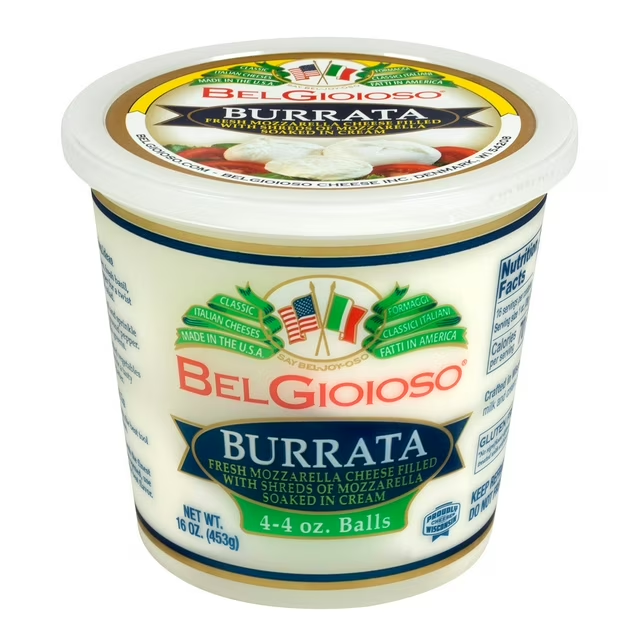
For six salads, one good-sized boule of burrata is enough. I have also used the individual BelGioioso boules sold at Costco. Once opened, burrata should be eaten quickly. But “What am I going to do with the leftover burrata?” ranks fairly low among culinary emergencies. Put it on tomatoes, grilled vegetables or pasta—or serve it with peaches. I suspect most of us can cope.
North to Modena
Our balsamic vinegar takes us north to Modena in Emilia-Romagna, a region that can make a food lover suspect the Italians have been playing with a loaded deck.
Traditional Balsamic Vinegar of Modena begins with grape must rather than finished wine. The must is cooked down and aged in a succession of wooden barrels. Time, evaporation and the different woods gradually make it darker, denser, sweeter and more complex.
This is slow food in the most literal sense. Traditional Balsamic Vinegar of Modena PDO must be aged for at least twelve years; Extra Vecchio requires at least twenty-five.
That is why the Modena illustration should show barrels rather than the cathedral or one of the city’s handsome streets. An attic lined with old wooden casks tells you immediately that this is not vinegar produced on Tuesday and shipped on Thursday. In Modena, traditional balsamic vinegar develops over years in a succession of wooden barrels.
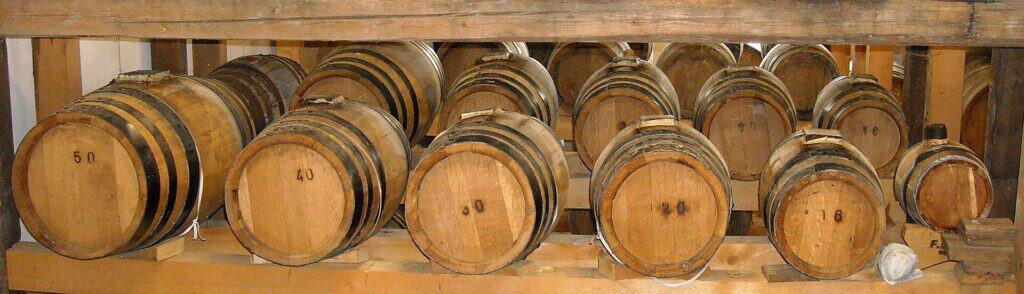 Traditional balsamic vinegar barrels in Modena. Vinegar2005, Public domain, via Wikimedia Commons
I am not suggesting that you pour a twenty-five-year-old balsamic liberally over six salads. A good balsamic vinegar that you enjoy is all that is required. Nor does it need to become a complicated vinaigrette. I use equal amounts of extra-virgin olive oil and balsamic vinegar. Nothing more. The burrata supplies richness, the tomatoes provide acidity and juice, the beets bring sweetness, and fresh basil takes care of perfume. Arrange everything on the plate, add the dressing and leave it alone. Good ingredients occasionally deserve that compliment.
Here’s the Tomato, Beet and Burrata Recipe.
The salad works because every ingredient has something different to contribute: the tomato is juicy and acidic, the beet sweet and earthy, the basil fragrant, the burrata lush and creamy, the olive oil fruity and the balsamic both sweet and sharp.Tomato Beet and Burrata Salad
Ingredients
Directions
Here’s a link to those other Tomato Recipes we promised you: https://chewingthefat.us.com/?s=Tomatoes
AND WHEN SUMMER ENDS, I CAN SCARCELY WAIT TO MAKE THESE AGAIN…SCROLL DOWN FOR THE RECIPE…
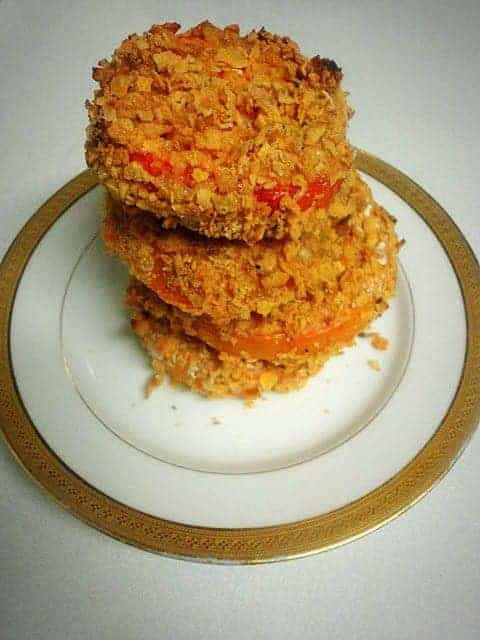
The Surprising Story of Fried Green Tomatoes and Martha Stewart’s Recipe for Non-Fried Tomatoes