As a steak connoisseur, few things ruin a dining experience more than cutting into a piece of steak, only to discover it’s not to your liking. It might not be cooked enough, or it could be overcooked, and it may even be chewy or lacking flavor. Finding failings in your steak begs the question: What determines the best steak? The following elements often contribute:
The Cut of Steak
You could visit the best steakhouses with glowing reviews, but you may still not have the best steak experience if it’s not your preferred cut. Different cuts have various flavors and textures to suit a range of recipes, accompaniments, and preferences.
For example, ribeye is often considered a flavor bomb for its richness, juiciness, and marbling. If you prefer your steak to be easy to cut and chew, a filet mignon tenderloin may be more to your liking. New York strip sirloin steak balances tenderness and flavor, while T-bone/porterhouse is both tender and flavorful.
Marbling
Marbling refers to the intramuscular fat in a cut of meat that enhances juiciness, tenderness, and flavor. The more marbled a cut of meat is, the more desirable it tends to be. Most steak grading systems are based on marbling. For example, the United States Department of Agriculture (USDA) graders inspect carcasses cut between the 11th and 12th ribs to assess their marbling. USDA grades consist of:
- Prime: The highest quality
- Choice: Balance of quality and price
- Select: Lean with the least amount of marbling
The Aging Process
There can be many steps for steak in between being removed from the animal and making it to your plate. If you purchase an aged steak, it may undergo a complex aging process that contributes to its flavor complexity.
A wet-aged steak sealed in a vacuum bag is tender, but often has less complex flavor. In comparison, a dry-aged steak that has been exposed to air for several weeks typically has a deep, concentrated, and nutty flavor, along with a tender texture.
The Cooking Method
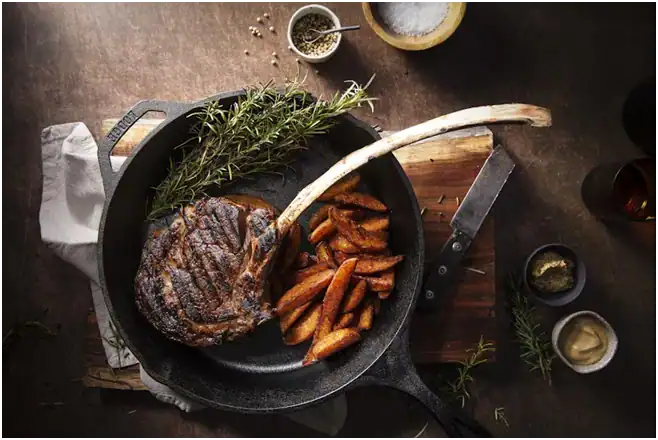
How you cook a steak significantly contributes to how pleasurable it is to eat. You can achieve a gorgeous, crusty, caramelized sear by cooking it on high heat in a broiler, on a cast-iron pan, or on a grill.
Cooking a great steak is also possible by basting it with butter, garlic, and herbs, like rosemary and thyme. For tenderness, a sous vide cooking method followed by searing can be a recipe for success.
Its Internal Temperature
The internal temperature of a steak determines how juicy it is. However, there is generally no ‘right or wrong’ temperature; just what you prefer. A rare steak, which is very tender and has a red center, is cooked to 120-125°F, whereas a medium-rare steak is juicy and pink, cooked to 130-135°F.
If you prefer a less juicy, slightly firm steak, you would cook it to medium at 140-145°F. A drier, mostly gray medium-well steak is cooked at 150-155°F, while a well-done steak is tough, with little moisture, cooked at 160°F or above.
Achieving the perfect steak might seem impossible, but it’s not. When you have your preferred cut, prepared in the right way, there’s every reason to believe your dining experience will be memorable for all the right reasons.